Distant Voices, Still Lives (Terence Davies, 1988)

Although Terence Davies would continue to direct singularly lyrical features over the course of his four decade career, the tender, autobiographical immediacy of his work finds its roots in his first two memory films.123 As a pair, Distant Voices, Still Lives and The Long Day Closes take on Davies’ childhood as a working-class Liverpudlian, a closeted Catholic and youngest of ten living under the regime of an abusive father. Davies’ father died when the director was just 7, and those subsequent years, reportedly the happiest years of Davies’ life, form the basis of The Long Day Closes.
Distant Voices, Still Lives is certainly about Davies’ memories of his father, but its relationship with time is much trickier. For starters, it’s the only Davies film without an obvious directorial stand-in, following a family’s (a mother, two sisters, and a brother) hazy memories of a violent patriarch as they undergo a series of weddings and childbirths. The film is as much an offering to his family, presumably drawing from some of their their adult lives, as it is an act of personal reminiscence.
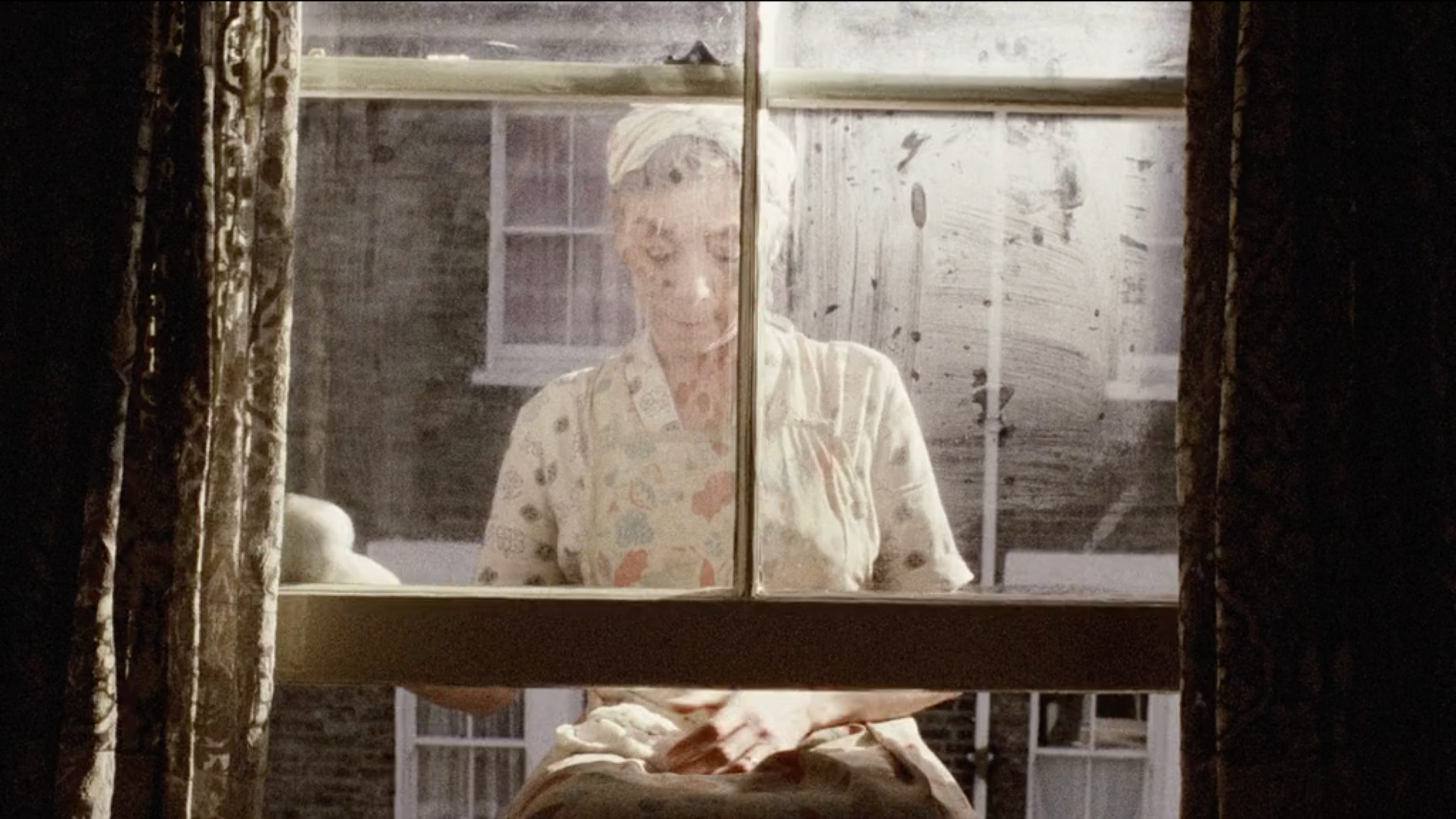
Distant Voices is a particularly interesting debut, because it represents the extremity of Davies’ style. It opens with a spectral sequence of the empty family home, establishing his use of sound-image disjunction and depiction of memory as free-floating collage. As a weather forecast mumbles in the background, we see the mother pick up bottles of milk from the front door and call the children downstairs to put on their skates. When they do, decades have passed and it’s the eldest daughter’s wedding day. The sounds of their footsteps and the family conversation play out over a still image of the staircase. When Davies moves the camera again, he floats through the house as the mother croons “I Get the Blues When it Rains”, eventually settling on a sunlit, curtained doorway. Only after a series of cascading dissolves depicting the family in mourning does Davies settle on a relatively stable timeframe.
From there, the film stitches the family’s memories to an amber-tinted depiction of the younger daughter’s wedding. In general, Davies favors the women, including two of their friends, Micky and Jingles, shooting them with Old Hollywood glamour as they engage in collective song and navigate burgeoning romance. He utilizes a logic of concatenation, linking horizontally-composed tableaus (shot low enough that they could be considered to be a child’s vantage point) through tracking shots set to selections from the Great American Songbook. Davies splits his time between the characters’ perspectives and his own, setting up narrative situations before zeroing in on the sensory details that have lodged in his psyche. A memory of an air-raid (which Davies would later echo in The Deep Blue Sea) diverts attention from Liverpudlians singing in the underground to gaze at the mother’s weary expression. During the wedding, Davies marvels at the texture of the sisters’ dresses and showers their faces with a reverent glow.
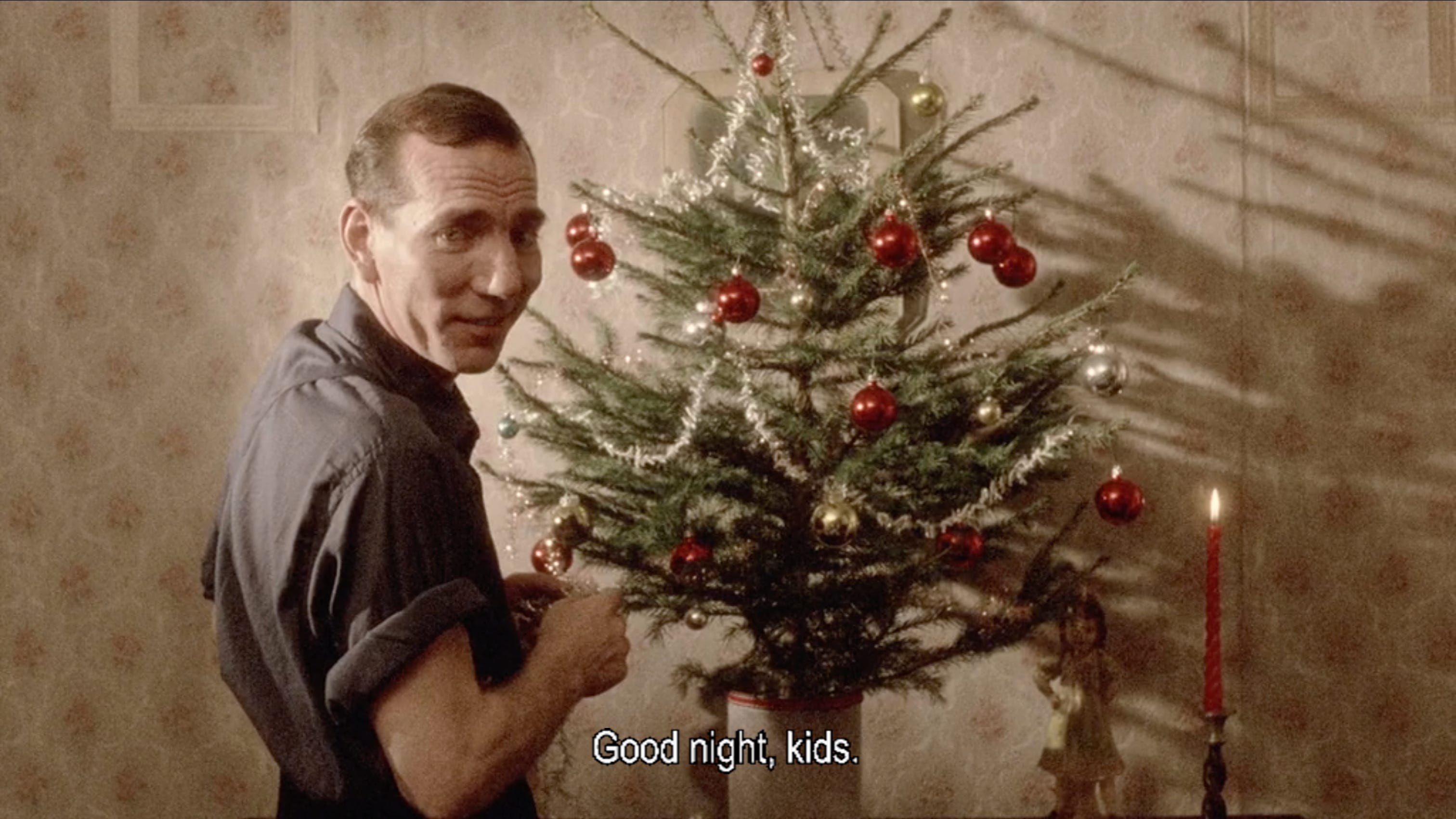
A particularly instructive sequence occurs early on. Backed by “In the Bleak Midwinter” and hushed snippets of conversation, Davies tracks from the bride and her brother in mournful embrace to a candlelit prayer to a precious memory of a family Christmas. It’s quintessential Davies, forging continuity between expressionist moments as if by divine intervention. The anguished framing of this particular flashback is indicative of Davies’ tortured ambivalence. For him, romance is inseparable from hardship, and he makes no attempt to reconcile the irreconcilable. The Christmas sequence concludes with the father violently destroying a table of food.
It’s worth noting that Distant Voices, Still Lives could be considered two films. The two halves, each with their own title card, were shot two years apart, with different crews and distinct formal strategies. Their linkage via an abstract sequence of moonlight reflected on inky water (an image that recurs in The House of Mirth and the end of The Long Day Closes) another instance of concatenation, this time in the film’s macro-structure.
Opening with the birth of the eldest daughter’s child and closing with the brother’s wedding, Still Lives is relatively straightforward, following the characters as they grapple with troubled family lives. The women find themselves in abusive relationships, their domineering husbands forcing them apart outside of communal events of baptisms, weddings, and birthdays. Still Lives has actual character-based drama, and it’s impressive how effective, say, Jingles’ breakdown at a party, is given Distant Voices’ poetic reverie. While music in Distant Voices functions mostly as an echo from the past, Still Lives functions akin to a traditional musical, where the bursts of collective song channel the suffering of domestic abuse and kitchen-sink gloom.
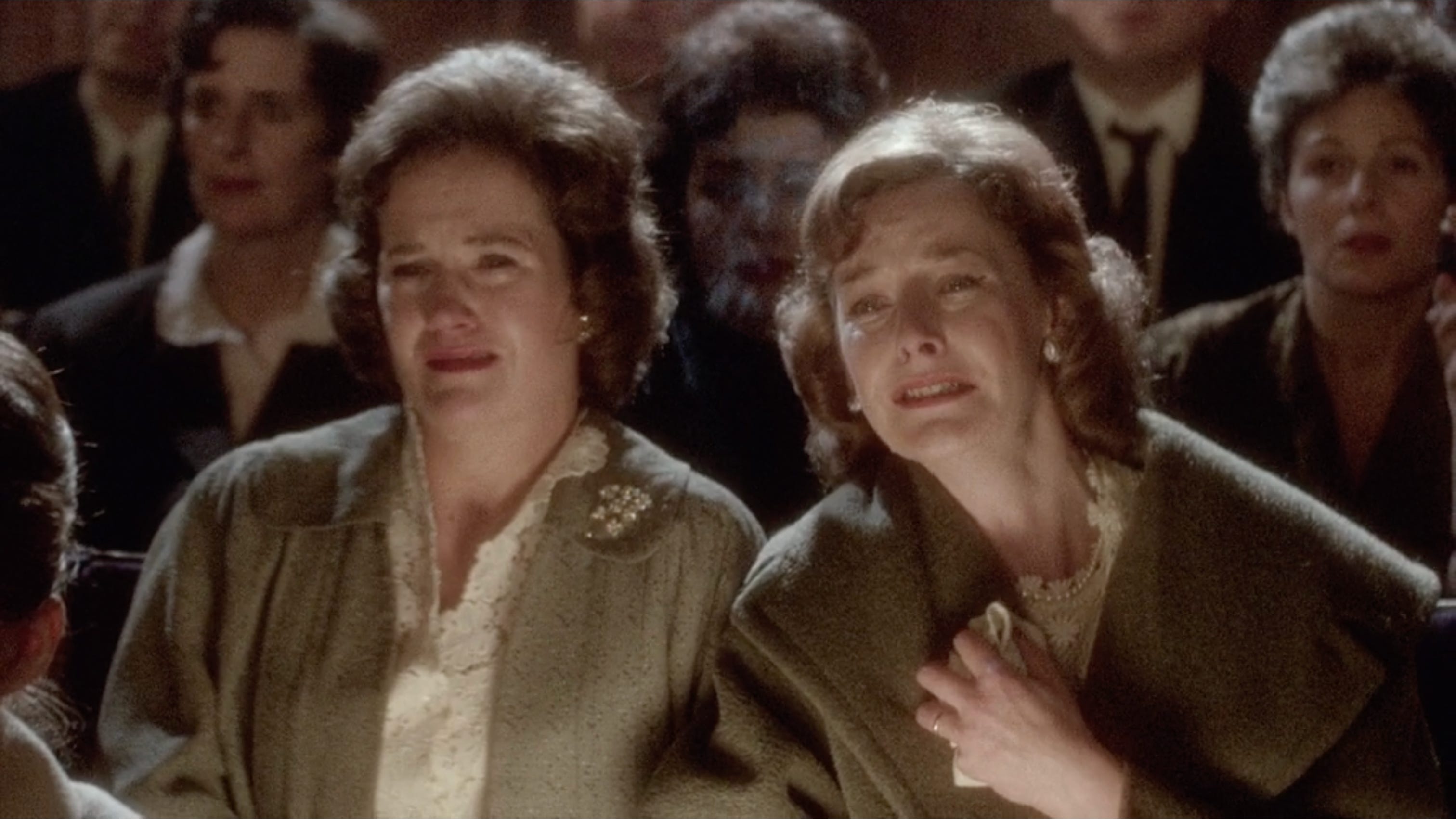
Music and movies form a counterpoint to the religious milieu, an alternative to the false promises of holy matrimony. Still Lives has a searching quality, its scenes demarcated by fades to white, and its soaring montages guided by a logic of ascension. It’s notable that the emotional climax occurs at the movie theater. A shot of black umbrellas (a nod to Singin’ in the Rain) is guided upwards towards a pair of movie posters and flickering streetlights. Proceeding into the theater, Davies rests on the sisters, bathed in heavenly light, crying to the theme of Love is a Many Splendored Thing. The musical catharsis incites a conflicted moment of wish fulfillment when one of the scoundrel husbands plummets from a piece of scaffolding in mythical slow-motion, but takes the younger brother with him. It makes intuitive sense that when the film subsequently returns to domestic ritual, it necessarily concludes. The brother’s wedding is depicted akin to a funeral procession, and the family wanders piecemeal into the shadows, fading into the recesses of Davies’ mind.
After Distant Voices, Still Lives and The Long Day Closes, Davies found a kinship with wayward 20th-century characters, wedding the avant-garde sensibility of his autobiographical films to more classical traditions of the literary adaptation and the biopic. Returning to Distant Voices, Still Lives now two years after Davies’ passing, there’s an additional sting. He never did set his eye towards the present-day, preferring to live, at least cinematically, in his stardust reverie, returning again and again to the era that birthed his uncommon sensitivity.