
2022 Dispatch: Benediction
Benediction contains some of the best 40 minutes of film you'll ever see. I went in depth with a couple scene analyses on Davies' style that could probably extend to the rest of his work.

Benediction (dir. Terence Davies)
How to Watch: Kanopy
Premise: A biopic about English poet Siegried Sassoon following the artist from his conscientious objector World War 1 days to the gay arts scene of post-war UK, to old age, where he’s married a woman and become a born-again Christian.
Thoughts: Since the early autobiographical films (Distant Voices, Still Lives, The Long Day Closes, and the fantastic Terence Davies Trilogy shorts) I mentioned in my writing on The Cathedral, Davies has transitioned to making films centering around figures that resonate with the primary themes that showed up in those early pieces such as his personal struggle with homosexuality and Catholic guilt to name a few. One (admittedly simplistic) way of seeing The Neon Bible, The House of Mirth, The Deep Blue Sea, and Sunset Song is that Davies found personal identification in literary characters struggling against societal codes. In A Quiet Passion, a film about Emily Dickinson, and now Benediction, which is about English poet Siegfried Sassoon, Davies is connecting with tragic artistic figures of the past. Even on paper, Sassoon, a gay man who made poems about the first World War and converted to Catholicism late in life, has clear parallels with Davies’ preoccupations.
The first section of Benediction, which largely covers Sassoon’s experience during World War 1, going from celebrated war hero to defiant objector, sees Davies return to abstract formal heights, the likes of which we haven’t seen since the opening of The Deep Blue Sea, which introduced Rachel Weisz’s irrational love for Tom Hiddleston through cascading impressions set to English gay 20th-century composer Samuel Barber’s lush violin concerto. This first section of Benediction likewise introduces the central emotional conflict of the film, namely the trauma of World War 1, which propagates through the rest of Sassoon’s life. One of the supreme pleasures of Davies covering poets is his use of their poetry spoken as voice-over mantras, weaving these artists’ work lyrically throughout their lives and memory. In Benediction, that poetry is often employed over stock footage. The opening of the film, which watches Sassoon watch a play, is set to one of Sassoon’s poems. The poem is about the start of World War 1, with scenes of the UK as young boys line up to go to war. As the curtain rises in the theater, it reveals itself as an anachronistic digital screen playing stock footage of said time period, ghostly images of boys in single-file ready to get in uniform. The sequence has the loaded emotion of a quintessential Davies sequence, the poem, lyrical, rhyming, clearly in the past tense, with Sassoon wrestling with the war, clearly personal, over more generic stock footage, the personal extended to all soldiers who lived through that time period. Connected to the diegetic present, it’s Lowden’s Sassoon stuck in the past, the stock footage, and the poem connecting past, present and future.
This sequence, also in the opening, which conveniently is on youtube, is another jaw-dropper. Lowden sits glassy-eyed on the couch as the camera revolves around him as a grief-stricken poem about soldiers lost in the war is played through voice-over. As we view Sassoon from behind, his gaze is matched by stock footage of the war dissolving over his fireplace. The poem slowly transitions into Silent Night, further emphasizing its lyric nature as a sort of mournful song, as Lowden dissolves into this footage, literally becoming part of it. The end of the scene returns to Sassoon on the couch, still immersed in the stock footage, as a gunshot from said footage is visually matched by Sassoon recoiling backward into a hospital bed, returning to the war where he’s been shot, falling into the past, which is also a diegetic present, where the emotional wounds of the “future” are literalized as physical gunshot wounds.
Discussing this film with a professor, he noted how these stock footage sequences verge on abstraction, which is a beautiful way of describing how the stock footage of war seems to exist outside of time, violence so painful that it feels like original sin, scrambling the chronology of the film from the very start.
I wouldn’t be able to finish this without going through my favorite sequence in the film, which isn’t set to a poem but to Johnny Cash. It’s another devastating example of Davies’ ability to convey this life-rupturing trauma that occurs at around the 15-minute mark. Sassoon, expressing his resistance to the UK’s continued participation in the war, throws his badge into a body of water, its cross-like shape totemically spinning, slowed down to highlight Sassoon’s name and title permanently etched into the back. As the badge falls into the water, the resulting splash dissolves into stock footage of the war, beginning with a herd of bulls running through fields before transitioning to more explicit footage of soldiers in the war, all set to Johnny Cash’s mournful Ghost Riders in the Sky. Eventually, a rear view of Lowden’s Sassoon dissolves into the frame, ultimately superimposing itself over the footage before the stock footage dissolves into a church pew. Davies’ camera then begins to slowly revolve around Lowden as an extended dissolve sees him transform into Peter Capaldi, Sassoon entering old age, converting to Catholicism, his portrait one of pain and guilt.
As I noted earlier, part of the emotional power of Davies’ stock footage is how Lowden’s figure seems to emerge from said footage, existing in both the abstract trauma and the present, the war having split him in two, his poetic observations a perpetual reflection of this grief, which sees itself mutating into religion later in Sassoon’s life. The dissolution into the church already implies causality, but this is formally explicated even further as Lowden dissolves into Capaldi within the same camera movement. It’s a stagnation; Sassoon trapped in the horrors of war, which we later learn in addition to trauma in the field, also includes the loss of a first gay lover in Wilfred Owen. This sequence formally links Sassoon’s experience in the war, which was the primary subject of his poetry, with the Catholic guilt that defines the mid-20th-century Capaldi sequences, which itself is entangled in the film’s mournful doomed struggle regarding Sassoon’s acceptance of queerness, his ultimate conformity to a heterosexual marriage at the expense of his own happiness. Looking back that initial imagery of Sassoon’s badge is the entire film. Sassoon is forever defined by his war title in his poetry, the war title and the cross quite literally two sides of the same coin, this individual quite literally dropped, left behind in the depths of war. It’s simply an unbelievably crafted scene, and I would be shocked to see it topped this year.
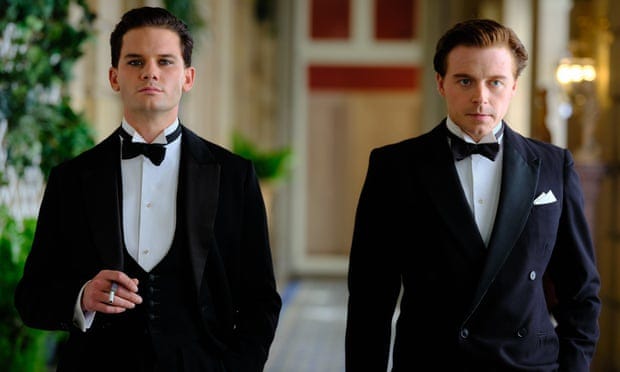
It’s hard to blame Benediction for never reaching the extreme heights of its first 40 minutes, which continues in a decisively more conventional mode, supplanting the more experimental time-traveling into abstraction of the opening section with switching back and forth between Lowden in the post-war period and mid-century Capaldi turning to religion, reflecting painfully on his life. The Lowden section in particular has surface-level pleasure. We see Sassoon enter the gay underground arts scene of the UK, interacting with such notable figures as Ivor Novello. While Davies is primarily regarded as a visual filmmaker, his dialogue is bitingly funny. It’s a joy to see melancholy, but ultimately really funny and flourishing catty gays form relationships, be messy, and fling artistic insults at each other, especially from Davies, who has always shied away from scenes of explicit homosexuality, in this film devoting a significant portion of the film to a gay milieu. The Capaldi sequences feel like a comparative trudge, and don’t quite haunt the Lowden sections as I think they’re meant to, especially when that function has to compete with the virtuosic power of the film’s opening act. One of the saddest lines does come from Capaldi though, who mentions that he hates the modern world because he’s too old for it, which feels like it could be directly from Davies himself, a succinct summary of the torturous emotion at the center of every single one of his films.