
The Odyssey (Christopher Nolan, 2026)
.

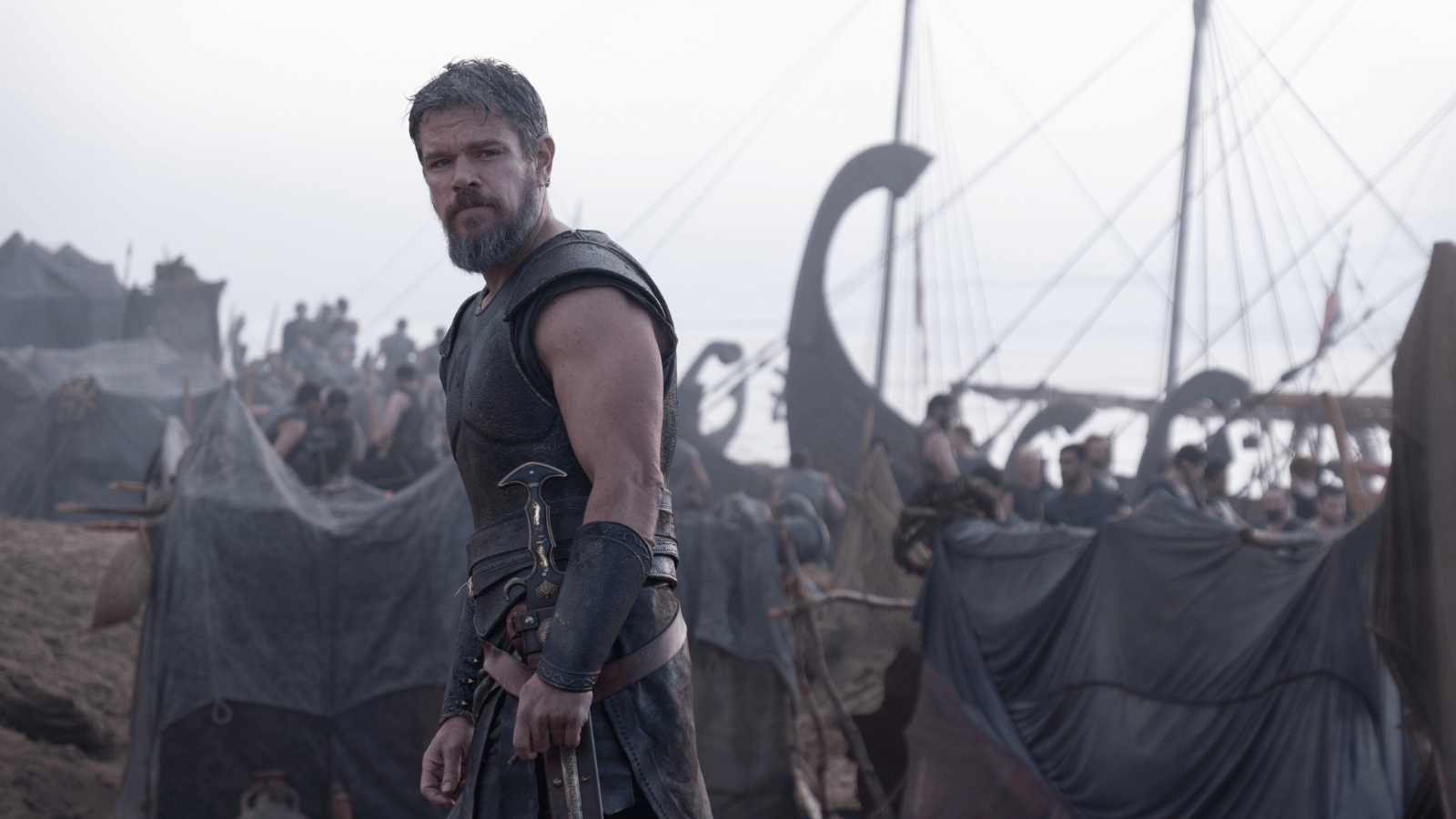
If nothing else, The Odyssey is notable for being Christopher Nolan’s biggest movie yet. For a pop-auteur whose brand has increasingly become his sweeping puzzle-box plotlines, expansive A-List casts, and premium-format fetishism, The Odyssey is his most action-packed and most star-studded feature. Plus, it’s the first film shot entirely on IMAX. For this occasion, Nolan has pared this self-conscious scale with a literal epic, providing himself the perfect marketing hook.
Perhaps Nolan set himself an impossible task in actually executing a feature that could live up to this extra-textual scale, but he also doesn’t do himself any favors. His Odyssey, with its tagline of “defy the gods” is resolutely earthbound, a knowingly contemporary look at the pre-modern world where the Ancient Greeks are just like us, but resort to mythical storytelling to explain say, a good harvest or shifting weather patterns. The result is a surprisingly straightforward account of a lyric text, depicting Odysseus’ homeward trials as episodic action-adventure and the simultaneous Ithaca-based politicking as predetermined chamber melodrama. For audiences in 2026, maybe The Odyssey is best understood as a super-sized episode of Game of Thrones, and though this period soap for men wears its spectacle on its sleeve, the images are generally functional, an airless and nondescript container for the timeless narrative.
Thematically, the central thrust of Nolan’s The Odyssey is the horror of a godless world. The Trojan War (a battle for trade routes, waged for Helen only in name), and the ensuing rampage of carnal sin enacted by Odysseus and his men erode Zeus’ law, leading to the collapse of civilization. In its identification with a guilt-ridden destroyer of worlds, The Odyssey isn’t too far from Oppenheimer, though to my mind, not quite as strong. Nevertheless, the modernity is an asset, the contemporary dialogue, best indicated by Tom Holland’s Telemachus calling his parents “Mom” and “Dad”, giving the film a distinctive, almost vulnerable, edge that coheres with the more intimate scale.
As Odysseus, Matt Damon is impressively world-weary, a melancholic family man haunted by his past, on a single-minded homecoming. Despite Damon’s strong performance, the script’s characterization of Odysseus is one of the film’s greatest weaknesses. Odysseus spends much of the film as an observer, a finger-wagging witness to the wrongdoings of his men who eat like pigs, slay sacred beasts, and ultimately pay the price. His own indulgence is insistently downplayed, a problem when the character’s regret hinges on his own complicity in violence, gluttony, and sex. When we first meet Odysseus on Calypso’s island, we learn that the two have engaged in a torrid years-long affair, but in Nolan’s eyes, the two characters are fundamentally chaste. Odysseus’ most reckless act of hedonism, his decision to listen to the sirens’ song, becomes yet another turgid reminder of his trauma. While watching Nolan’s film, it’s hard not to be reminded of the carnality of mythical adaptations by Pasolini, Piavoli, or Serra, sweaty, dangerously seductive films where you can practically feel the beams of sunlight on the characters’ bodies.
The Odyssey largely gets by on its tried and true narrative though its moment-to-moment enjoyment is dependent on the quality of the particular episode. I particularly liked the encounters with the Cyclops and Tiresias, as well as the flashbacks to the Trojan War. The intermittent check-ins with Penelope and her suitors are notably weak (Tom Holland bad as Telemachus, Hathaway sadly uninspired) until the basic thrills of Odysseus’ revenge. In this epic journey to the end credits, mileage indeed varies.
The Odyssey is distributed by Universal and in theaters now.