
New Experimental Shorts: Viktoria Schmid, Johann Lurf, and Prismatic Ground

Rojo Žalia Blau (Viktoria Schmid, 2025):
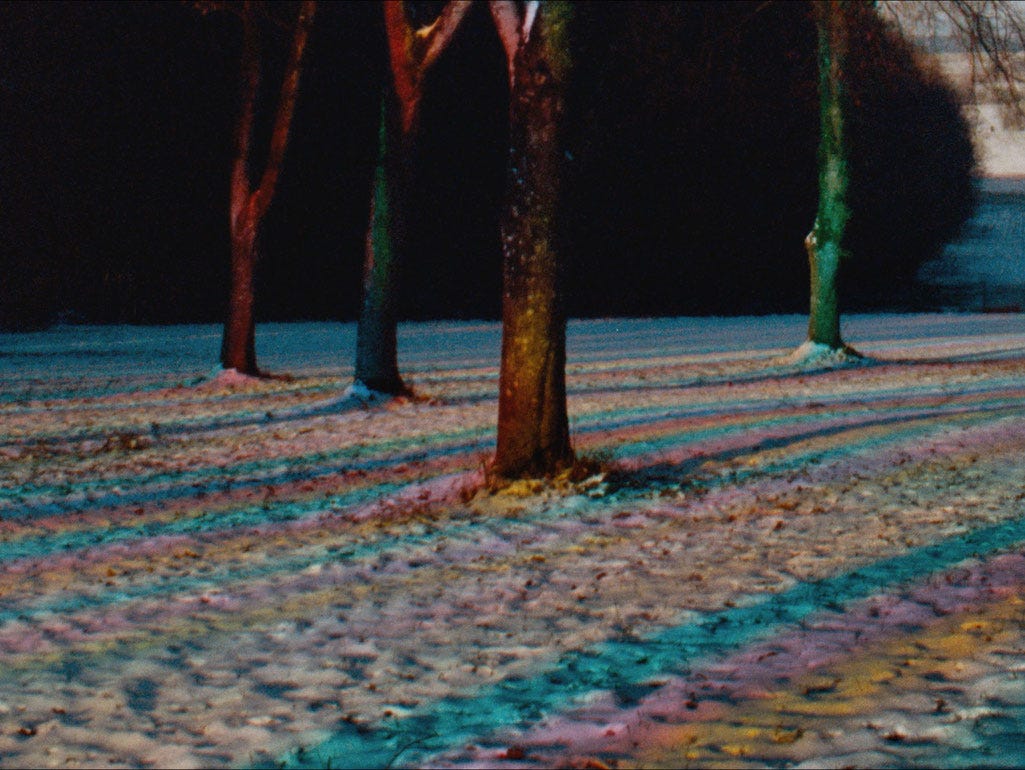
Rojo Žalia Blau is an expansion on the project Viktoria Schmid began with her miniature city-symphony NYC RGB. Inspired by technicolor coloring methods, she passed ambient shots of the city through red, green, and blue filters and overlaid them, resulting in images that shifted in color depending on the offset natural motion. I actually discussed NYC RGB when it played at SIFF a few years back and Rojo Žalia Blau contains many of the same pleasures, taking the technique’s elegant, psychedelic layering of time beyond city limits.
I actually may prefer this latest installment. Shot in various landscapes across Spain, Lithuania, and Austria (note the three languages in the title), this film sacrifices some of NYC RGB’s conceptual concision for more dynamic visual effects. For one, some of the forests and coastlines already contain bright greens and blues, so different colors are emphasized in different shots, creating effects like cotton-candy clouds and waves with Christmas highlights. The micro-movements of the outdoors, whether that be rustling leaves or flies swarming in the frame, create a trippy, trembling frame that sometimes looks like an unfocused 3D image and at other times like impressionist broken-color technique. When the frame is still, the effect of seeing tree shadows creating colored streaks across tree trunks and snowscapes is endlessly satisfying. At a few key moments, Schmid shows us an unfiltered image, and the return to the color-separated version animates the landscape with subjectivity and history.
I’m still chewing on Schmid’s decision to shoot in three different countries. While there’s no mistaking the beaches with palm trees as the same location as the alpine forests, Rojo Žalia Blau loosely de-contextualizes these landscapes, threading space as well as time. This spatial effect is secondary, but I wonder if there’s a political subtext to these landscapes that I’m not grasping. Nevertheless, Rojo Žalia Blau taps into the essence of the medium in a way that’s both refreshing and profound.
Forever…Forever (Johann Lurf, 2026):
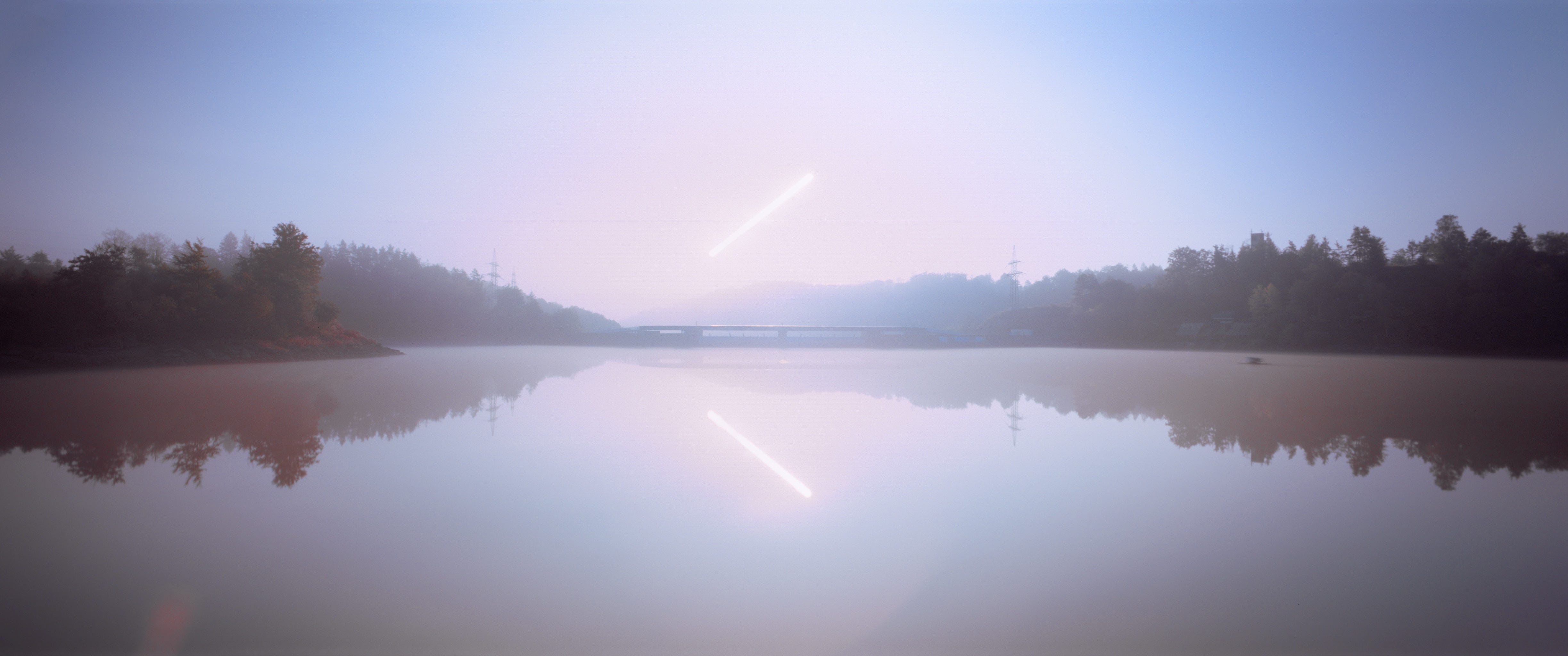
Operating on a much grander scale is Johann Lurf’s Forever…Forever, which premiered at Berlin this year on a 70mm print. Much like when Michael Snow made a film commissioned by IMAX, the large-scale format is indicative of Lurf’s aim to turn cinema’s ability to alter perception into grand spectacle. Lurf’s structuralist thrills generally have a tumbling shape, taking a basic cinematic premise to an extreme where reality “cracks”. In Vertigo Rush, a dolly zoom accelerates to strobing warp-speed while in Revolving Rounds, a 3D zoom into a greenhouse breaks down into a montage of microscopic plant cells, before further splitting into pure film grain.
Forever…Forever is a static timelapse, condensing twenty-two months of footage into twenty minutes. The composition is of an Austrian reservoir, the frame horizontally bisected by the human structures while the water reflects natural fluctuations. The ambient soundtrack is timed such that sunrise and moonrise produce a sort of bell-tone, while lightning strikes create a pretty funny noise not unlike a computer pop-up. Accelerating exponentially, the film first becomes a swinging light show as the world seems to explode from and retreat into the static reservoir. By the end, the day-night cycle is a strobe, the sun and the moon a laser beam drilling into the frame, the soundtrack a harmonized, heavenly drone.
The movie is a blast, and one that prompts similar questions I have about Lurf’s other films - namely, does this image of non-human time feel more representative of the cosmos or the camera? This feels especially potent here as Forever…Forever’s starting point could conceivably be a human looking out onto the reservoir. Perhaps the film’s subject is the reservoir itself, a static structure surrounded by swirling natural phenomena, its gaze projected onto the dimensions of the frame. The film does convey a sense of natural wonder, but it’s also about the unstable, god-like temporality of the camera and the unnatural plasticity of the film image. I hope the 70mm print travels.
Prismatic Ground:
Last weekend, I checked out some of the online offerings from Prismatic Ground. This is the sixth edition of the New York-based festival, led by Inney Prakash, which specializes in experimental documentary and is one of the most exciting festivals in the US.
One of Prismatic Ground’s most exciting sections is always its retrospective programs. Whether it be an experimental or narrative repertory program, Prakash is able to find underseen, generally unavailable work that feels like it expands our understanding of film history. When I was able to briefly attend the festival in person last year, I was especially excited for the festival’s retrospective for Parallel Cinema filmmaker Kumar Shahani. The rare 35mm screening of his Khayal Gatha was one of my favorite viewing experiences of 2025. This year the festival put a spotlight on Japanese filmmaker Kohei Ando and a trio of restored shorts from Iraqi-Lebanese filmmaker Parine Jaddo, with Jaddo’s first film, 1995’s Atash (Thirst), available in the online program.
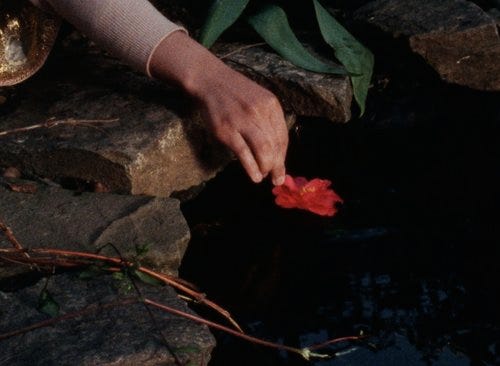
Atash (Thirst) was the probably the best thing I saw from the fest. Initially, a man narrates an ancient tale of doomed lovers interspersed with domestic snapshots from 1990s Beirut (e.g. a child showing his mother a drawing, the mother reading a book). In the final minutes, a woman, presumably the mother from the preceding segments, wrests control of the narration, telling the same story with contemporary resonance, describing the lovers’ hedonism as a desperate response to the bombings outside their window. It’s a beautiful film, shot with a lyrical devotion to color and montage, that conjoins the realms of the masculine and the feminine, the ancient and the modern, the narrative and the documentary through an act of personal mythology.
phototropes, a three-minute miniature from Blanca Garcia and James Devine, captures poetic images of sunlight as it moves across Frankfurt’s Palmengarten. Most of the film focuses on various plants, either in rapidfire montage or Dorsky-esque plays with exposure with a few shots of portraiture. I liked it, but missed that alchemical click that turns a short like this from a collection of beautiful shots into something great.
Another site-specific work was Lee Jangwook’s Chang Gyeong. Originally designed as a royal palace, the Chang Gyeong Palace was incinerated and reconstructed by invading Japanese forces in the 16th-century, at which point it became a botanical and zoological garden. Reformed into a symbol of colonial dominance, the garden grounds fluctuated with the influence of the Japanese empire, culminating in mass killings of the animal inhabitants during WWII and the Korean War. In 1983, a new rehabilitation project restored the site to its original palatial form.
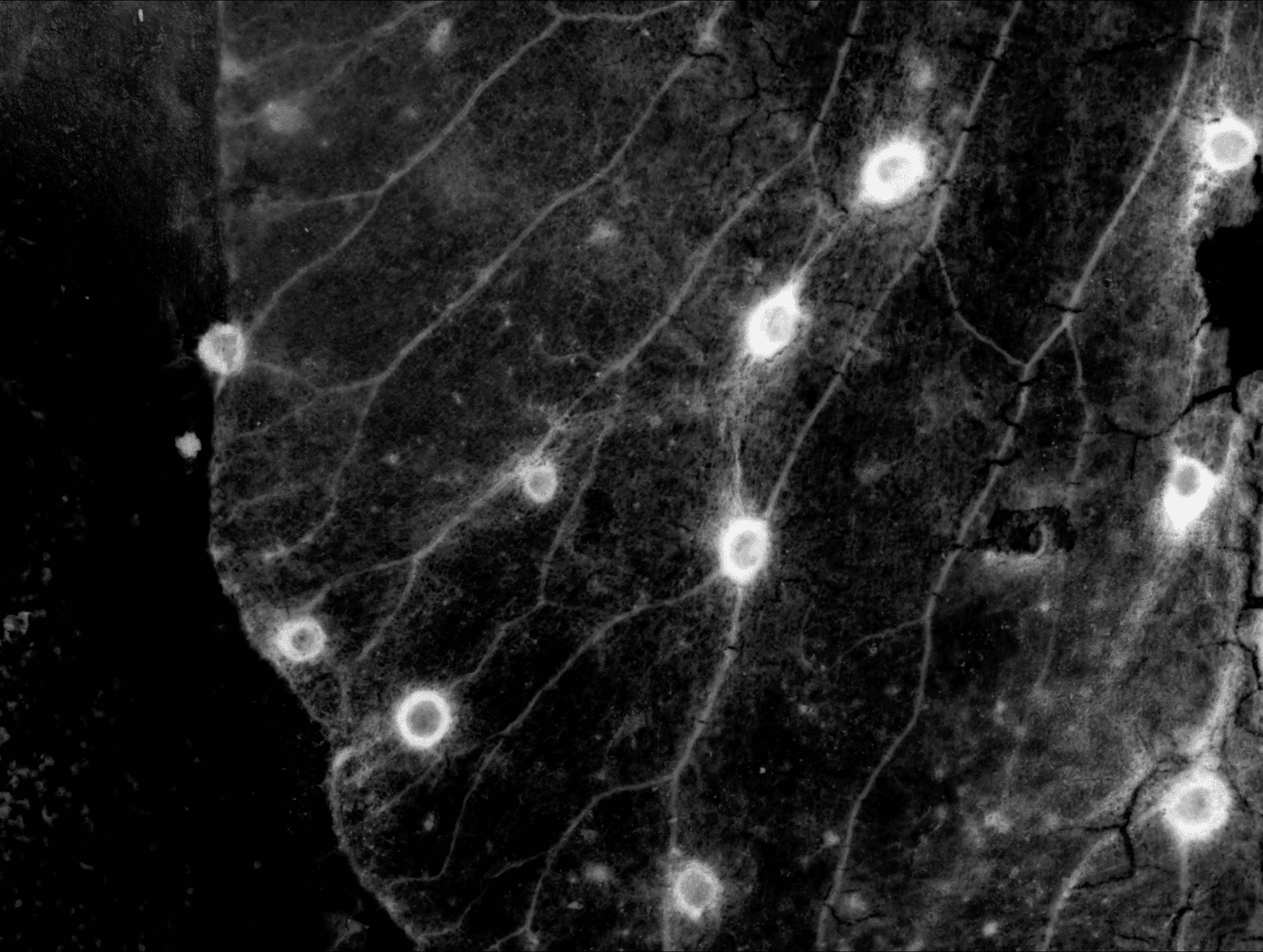
Lee’s film reflects on this ongoing history in oblique, often obscurant form. Organized in movements separated by onscreen text, a majority of the film is multi-exposure black-and-white forms that evolve as we learn more about the space. Initially, it’s possible to discern some of the images as plant material blending in and out of focus as one layer of the image rapidly cuts while the other moves laterally. Eventually, these images are also layered with what seems to be bird dissection imagery, which primarily looks like scissors cutting through amorphous flesh. The eeriest part of the film though is a brief snippet of color, ambient footage of the palace today. The film is an unsettling avant-horror that’s feels perpetually unformed.
Split into four discrete tableaus, Felix Caraballo’s Anomalies in a Landscape feels like a series of experiments with the camera, with the anomalies in question being the imposition of human presence. Each seems inspired by a specific influence. For example, there’s one where sections of the frame are partitioned by cards and pages that recall From the Notebook Of… and another that’s either hand-painted or dragged through the landscape itself. If it sounds like it’s hard to tell, it’s because the entire film is covered in a bright blue filter, only emphasizing the film’s unreality.
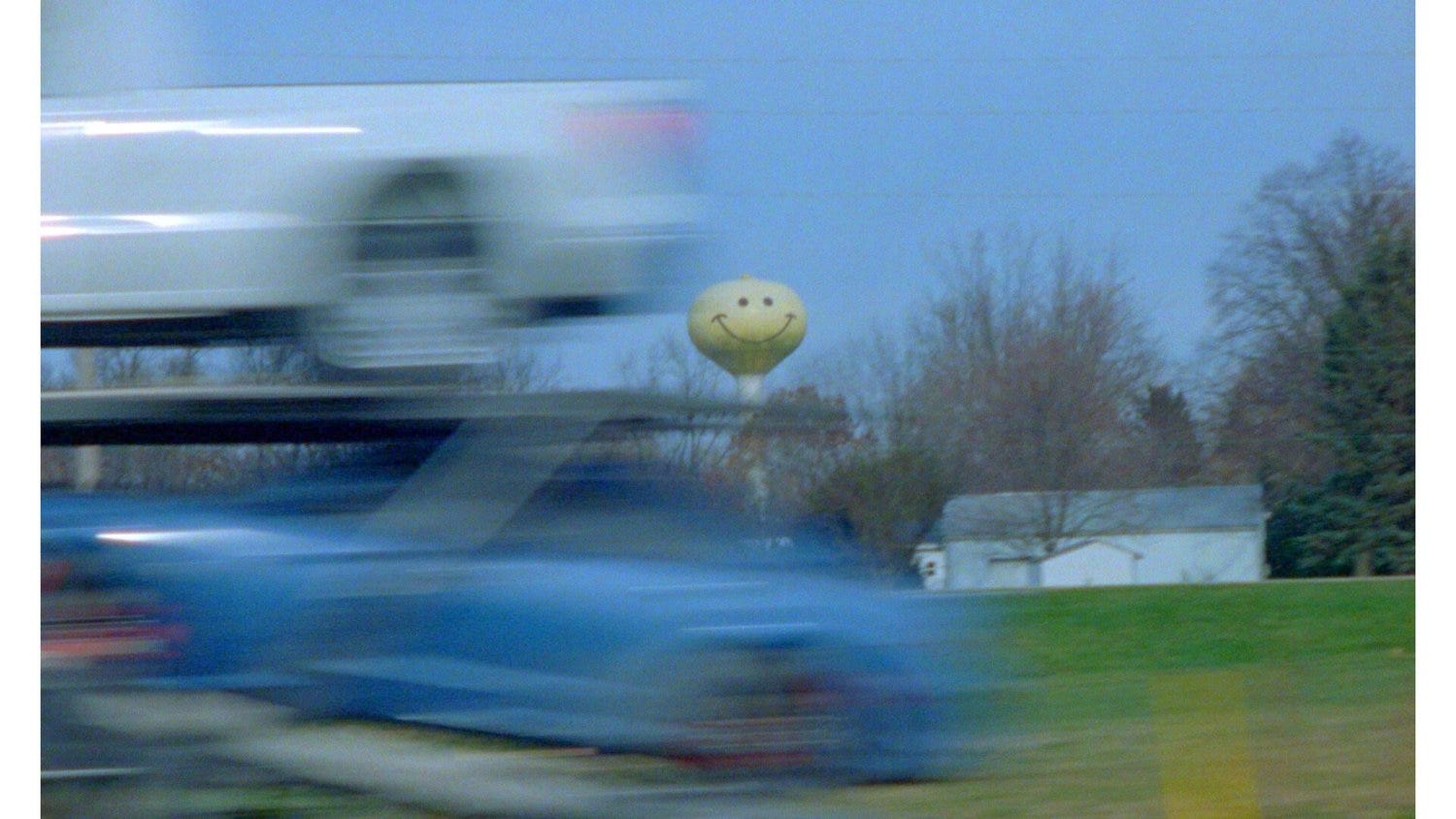
In a totally different register, I had a good time with Einslow Johnson’s Injured?, which I clicked on because the thumbnail includes a water tower featured on an old underscores album. The title comes from personal injury billboards scattered throughout freeways on the Midwest. Tapping into the billboards’ premonitory aura, Einslow imagines a road trip driven by a crash-test dummy. It’s a kitschfest, an onslaught of billboards and Midwest sleaze that goes through an impressive number of styles from stop-motion animation to Brakhage-y outbursts set inside a car wash. The most interesting thing about it is actually an invocation of Venom, with sequences from the Tom Hardy’s press tour playing on loop inside a gas station. The link between marketing and brain rot isn’t anything super new at this point, but Johnson’s culturally-specific and well-crafted take is a lot of fun.