
Magellan (Lav Diaz, 2025)

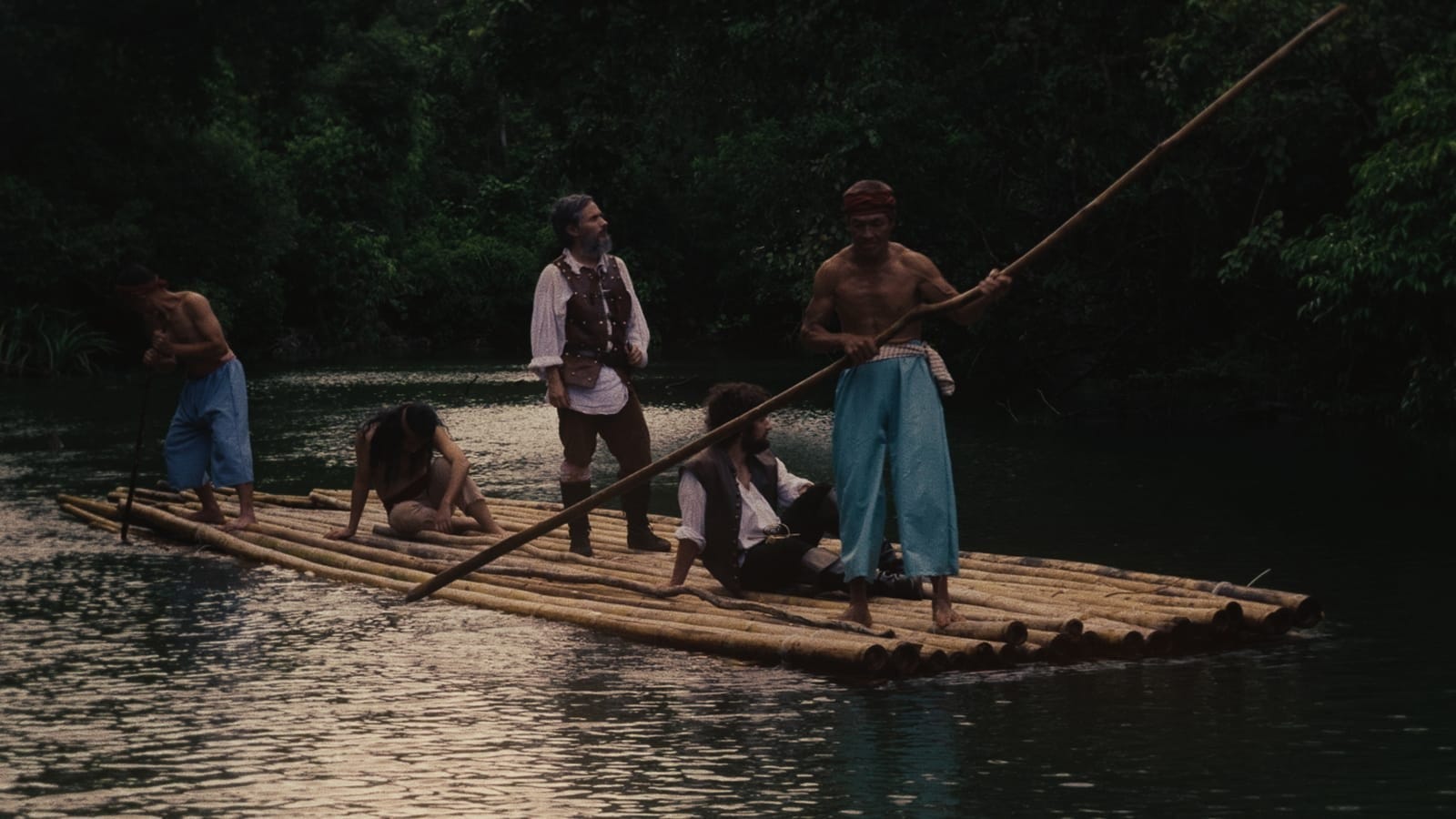
Since 2001’s Batang West Side, Lav Diaz’s unique position in the festival circuit is connected to the punishing runtime of his films, which are frequently over 6-7 hours long. At a mere 160 minutes, Magellan looks like a play for the arthouse mainstream, and is destined to be Diaz’s most widely distributed feature to-date. It’s one of Diaz’s only color films, his first with an movie star (Gael Garcia Bernal), and his first international co-production (produced by Albert Serra and shot by Serra’s regular cinematographer Arthur Tort). Most importantly, the film is reportedly an excerpt of a 9-hour epic, Beatriz, the Wife, Magellan’s partner about whom much less is known.
The choice to extract a film like Magellan out of Beatriz, the Wife signals an awareness of the market. Magellan is both a “great man” biopic and part of a recent lineage of“cosmic slow cinema portraits of colonial emissaries”. The shadows of Pacifiction (directed by Serra), Almayer’s Folly, Jauja, and Zama loom over Magellan, and on some level, Magellan is a response to this trend.
One way to read Magellan is that as the first man to circumnavigate the globe, his is also the origin story of these slow-cinema descendants, often directed by the formerly colonized and funded by European sources. It seems intentional, for example, that Magellan’s opening shot is a reference to an early scene in Lucrecia Martel’s Zama. Before Magellan ever appears onscreen, the first of many static, deep-focus shots sees a Malaccan woman startled by the presence of an unseen white man, the fateful encounter depicted as a fourth-wall breaking look into the camera. On one hand, the woman is calling attention to the film’s presumed Western audience, but she’s also stating a documentary fact, since Arthur Tort is standing behind the camera.
Throughout the film, Diaz plays into contemporary cinema from colonizers and the colonized. Scenes in the jungle recall Lisandro Alonso’s Los Muertos (the disembodied tracking shots) and Jauja (a detour to Patagonia to drop off two mutineers), while in Lisbon, Magellan’s gangrene treatment invites comparison to Serra’s The Death of Louis XIV. The casting of a Mexican movie star as an inscrutable Ferdinand Magellan is also a quintessential Serra move. Even the expedition itself, led by a Portuguese man, funded by the Spanish (see: Serra and Tort), translated by a Filipino slave, is a metaphor for the state of arthouse film production. Diaz is the self-effacing auteur stuck translating imposed aesthetics.
A cursory knowledge of world cinema isn’t a pre-requisite to enjoying the film, since Magellan is consciously an elegant, deceptively straightforward anti-colonial biopic. The film chronologically follows the explorer’s final years, depicting his conquest of Malacca, his expedition pitches in Europe (where he meets Beatriz), the grueling voyage across the Pacific, and finally, his doomed stint in the Philippines. The sense of observing the distant past is generated by Diaz’s formalist approach of stationary tableaus, making good use of Tort’s primordial treatment of light. Every shot is a seductive still-life, and Diaz’s extreme use of the frame (he loves to put objects in the bottom left foreground) is obviously the work of a master filmmaker.
Magellan’s subject is the religious fervor underpinning European conquest, and the ways religion is used as a justification for wanton violence. Diaz isn’t subtle about the condemnation of religious hypocrisy. One of the first scenes sees a Portuguese commander describe his dream of crushing Islam to prepare the world for judgment day before dropping dead in the next shot. Back in Lisbon, a poet confronts Magellan about the trail of unconscionable violence left in the wake of his sailings only to be violently beaten. If the film weren’t pointing towards a deeper spiritual void, this didacticism would feel cheap.
Just as Magellan sets up a dichotomy between modes of film production, it’s also structured around warring spiritualities, with differing compositional strategies corresponding to the film’s gradual shift in identification. Magellan hinges on two Southeast Asian rituals to the gods of water and wind, each in response to the sighting of a white colonizer. The first section in Malacca sees Magellan entering tableaus of colonial bloodshed, composed like Romantic European paintings. Discovering these body-strewn landscapes after the fact, Magellan is a constant colonizer of the frame, the violence depicted as an act of divine will.
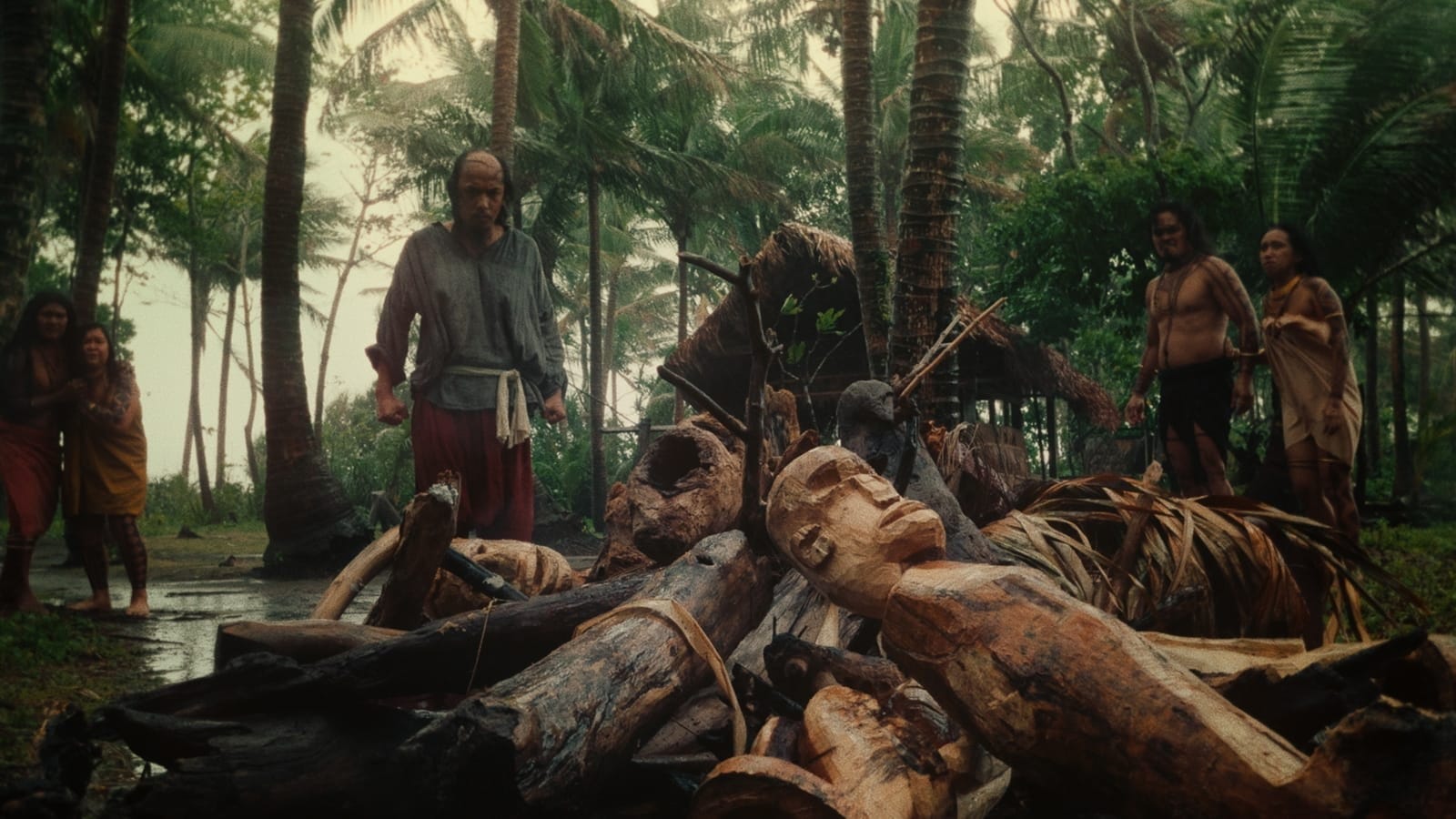
When Magellan touches down on Cebu Island and Diaz turns his eye towards the Filipino tribes, the images reflect their animist beliefs. It’s surprising how ambivalent Diaz is about some of these pagan rituals. A shot where the bodies of sacrificed children are served to the ocean is shot from an extreme low angle so the subject of the shot is the waves crashing onto the beach. Later, when nearby tribes begin to convert to Christianity, shots of crowds huddled around statues of Jesus are depicted in extreme long shots, concentrating the spiritual energy in the trees and the wind. Nature is an active presence in Magellan’s final stretch, disfiguring classical compositions. When a battle breaks out, carried out in the name of an imaginary Filipino tribe leader Datu Lapu Lapu, foliage obscures the deep-focus imagery, in one instance covering and stopping a rape.
The most interesting stretch of the film takes place on Magellan’s boat, The Victoria. Diaz treats circumnavigation as an abstraction, expository labels while bodies and minds rot at sea. The voyage is a cursed amalgam of world cinema signifiers. It feels like an Albert Serra movie, especially when beautifully rendered gay sex becomes involved, Magellan’s turn as a middle manager and petty dictator pulls from Zama, and the phantasmagoric visions of Beatriz play like Manoel de Oliveira. It’s also in this no man’s land that we formally meet Enrique, Magellan’s Filipino slave who acts as a translator between him and the residents of these “newfound” lands. Enrique’s history, passed between Chinese, Arab and now European owners, reflects the problem of Filipino identity formation, and he’s a voiceless directorial avatar. Magellan ultimately becomes a stealth portrait of Enrique, who delivers the film’s final lines, reflecting on his implication in colonial violence as a means to freedom.
If I have some hesitations about Magellan, it’s because to love this film feels like falling for a conscious act of selling out. The atmospheric resplendence, the integration into world cinema, is a calculation, its function made explicit by the film’s reveal of its actual protagonist. Magellan’s success then, is that it positions Magellan’s story as a jumping off point for more original cinematic interventions. It’s a gateway for Beatriz, the Wife, but also for more Filipino perspectives on colonialism. This is Diaz’s bread and butter, but he’s also aware that another Filipino master, Kidlat Tahimik, adapted this same story from Enrique’s perspective in 2015. Magellan is a shadow film, its subject of contemporary artistic repression and its post-colonial roots a phantasm haunting an immaculately constructed facade. It’s to Diaz’s credit that this facade is a gripping film in its own right.
Magellan is distributed by Janus Films and is in theaters now.