
In-Flight Entertainment Pt.1
On the Oscars, Sirāt, and some in-flight treats from Seattle to Tianjin

It’s been a month and a half since I’ve posted on here, a break that came about from a combo of being in China for a few weeks (Tianjin and Chengdu), a general lack of interest in new releases, and burnout from work, festival pre-screening, grad school craziness, etc. I’m back now and the day before the Oscars feels like as good a time as any to dive back in. As for this year’s race, it’s seemed clear from the start that this is a race between Sinners and One Battle After Another, which may be why this awards season feels particularly exhausting. I have reservations with both films, but acknowledge that as far as tentpole blockbusters go these days, these are well worth celebrating. If I had to rank the BP nominees, it might look something like:
Great:
Marty Supreme
The Secret Agent
I Liked It!:
One Battle After Another
Meh:
Bugonia
Sentimental Value
Sinners
Nope:
Hamnet
Train Dreams
Not an amazing track record for my tastes, but I also can’t remember the last time two of my favorite movies of the year were nominated for best picture. All in all, this is a respectable year. I’m excited for the big show. Let’s get this over with (and give my 甜茶 his trophy please).
Sirāt (Oliver Laxe)

Before I get into some movies I watched on the plane, let’s talk about Sirāt, which surprisingly bagged two nominations in International Feature and Sound. It’s a film that’s been on my mind lately, especially after I saw videos of gays trying to keep the party going in PV during the onset of the recent cartel violence. I first saw the film at home late last year, and had been waiting to see it presented theatrically before trying to write about it. There’s no doubt it’s an accomplished film, but it’s also one that plays on incredulity, as if daring the audience to take it seriously. Sirāt is another post-Zone of Interest take on cognitive dissonance, but with a trickier attempt at character identification. The subjects are a group of Europeans who have decamped to Morocco for a series of desert raves, generally oblivious to the fact that their escapism is on land that isn’t theirs. When global conflict breaks up the first rave, the foolhardy Europeans break out of their forced evacuation to find the next dance floor, only to discover the flimsiness of their white privilege.
What I generally appreciate about Sirāt is its line between the symbolic and the material, how the desert is a mythical wasteland to the Europeans, but a lived reality for the few locals they encounter, how the inciting incident is both based in a real conflict, but is also some abstract World War III. Perhaps the litmus test is a visual rhyme Laxe makes between dancers crowding around a speaker and Muslims circling the Kaaba, a comparison that’s both earnest and open to ridicule. When the survivors are left on a literal road to nowhere, even the overall vision of apocalypse feels like a product of whiteness. The tragedy in Sirāt is absurd, and my main hangup is that Laxe’s attempts at humanizing these subjects (including casting actors with missing limbs) feels like blatant puppeteering, never quite achieving the audience implication I think he’s going for. The film is a blast (literally), but the results also feel pre-processed.
Manoel’s Destinies (Raúl Ruiz):

On my flight from Seattle to Seoul, I threw on Raul Ruiz’s utterly entrancing Manoel’s Destinies. Conceived as a 3-part television program for children, the film opens with an encounter between young Manoel, his future self, and a magical fisherman. Convinced that his future (including the death of his parents) hinges on this fateful encounter, the film unravels into a labyrinthine series of anxious fantasies, balancing its fears (the inevitability of death, abandonment) with a playful, childlike wonder.
It’s worth saying upfront that Manoel’s Destinies is beautiful, particularly in the counterpoint between the naturalist depiction of windswept Portuguese coastlines and Ruiz’s psychedelic expressionism. Taking on a child’s point of view, he finds the fantastical in the most basic of cinematic techniques, using extreme angles and foreground-background relations. Among other things, Ruiz suggests that we’re nowhere near finished with the possibilities of smeared lenses, shadow work, and color filters.
Someone more well-versed in Portuguese history would be better equipped to dissect Manoel’s Destinies’ political import and its repeated reference to the nation’s future (at the very least, I caught that the film takes place just after the Carnation Revolution). What’s clear is that Ruiz is interested in the spiritual value of wonder and the pleasures of narrative, depicted in the final chapter as a magical piece of lace. At the start of the second episode, Manoel’s villainous teacher takes his students to the countryside, hoping to manifest the construction of a hospital through their collective dreaming. Uninterested in utility, Manoel wanders away and swaps bodies with another future self, first seen beating wine out of a tree. By the truly delirious final segment, the soaring musicality is a product of the risky narrative incoherence.
Wolfsburg (Christian Petzold)
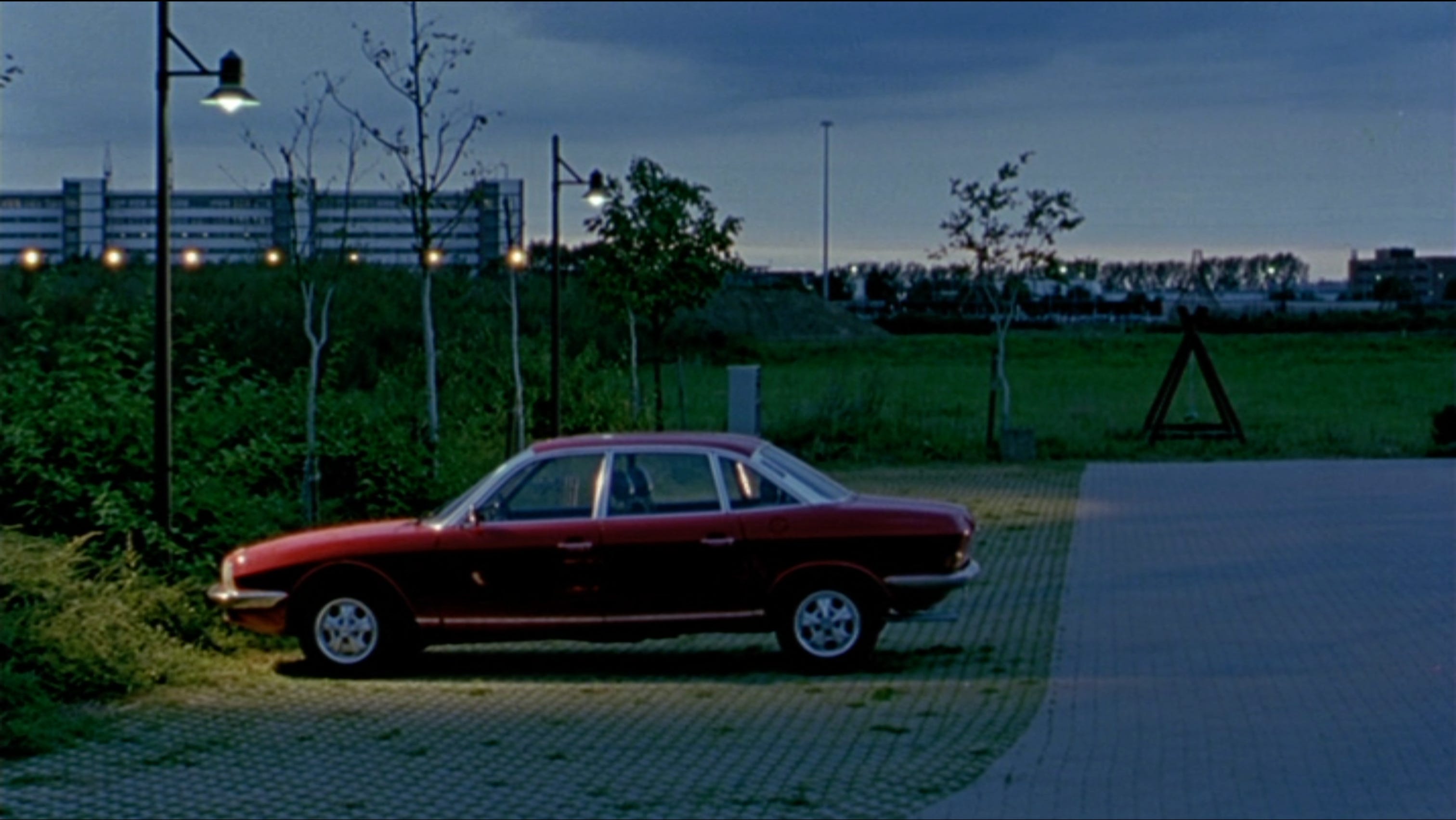
For the second leg of my trip, I caught up with Wolfsburg, one of the few films I’d yet to see by Christian Petzold. While arguing on the phone with his fiancée, Phillip (Benno Fürmann) runs over a young boy and flees the scene of the crime. The encounter leaves his personal life in a state of disarray. He begins to follow the bereaved mother throughout the city, doing everything but admit to the crime. Phillip’s fiancée interprets the suspicious behavior as an affair, complicating his employment at her brother’s Audi dealership. The bereaved mother, Laura (Nina Hoss), is a supermarket employee already fending off romantic advances from her manager. Amidst her depressive investigation, she slowly warms to Phillip’s insertion into her life. While the narrative initially seems like a play on Naruse’s Scattered Clouds, the pair spend most of the film’s runtime orbiting each other, stewing in the wreckage of mass industrialization and Phillip’s cowardice.
Wolfsburg works best as a fatalist depiction of urban life, with characters looking for connection in non-spaces of parking lots, office spaces, and dumpsters, masking their emotions in monetary transactions. Embarrassingly, it didn’t occur to me until the end of the film, and its similarity to Phoenix, that Phillip’s silence also connects his role in the auto industry to Germany’s Nazi’s past. I love this early period of Petzold’s career, where the everyday realities of urban life were the basis of the drama, and this is a typically accomplished outing from him.
YES, Raul Ruiz!! I actually haven't seen Manoel’s Destinies yet, but it's on the list. He's one of my favs. How in the world did you manage to watch one of his films on a flight? Good job if you were able to pull off that kind of committed attention!