
In-Flight Entertainment Pt. 2: The Last Year of Darkness
On Ben Mullinkosson's The Last Year of Darkness

My trip to China went differently than usual this year. After spending some time with family in Tianjin, I flew down to Chengdu with three friends for a little less than a week. It’s the first time I’ve really explored China with friends, and we were all curious about what young people in China are like. One of the reasons we picked Chengdu is because for years, we’d heard that it’s China’s “gay capital”, a.k.a Gaydu. Before leaving China, I was reminded of The Last Year of Darkness, Ben Mullinkosson’s documentary about the city’s underground gay club scene that made a bit of a splash a few years back.
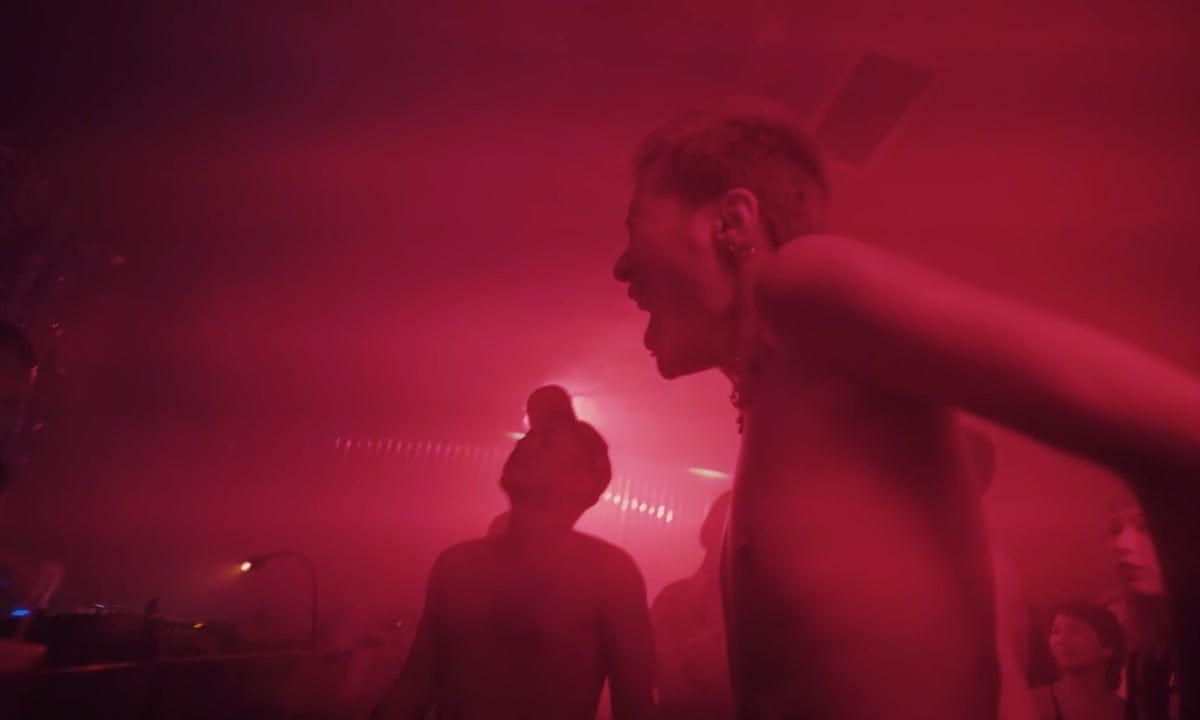
I watched the film on my way home in a lounge at the Seoul Airport, which felt like a suitably transitory place to watch this movie about young queers in a rapidly changing city. The characters in The Last Year of Darkness all frequent the club Funky Town, a neon-lit escape from the economic and social pressures of contemporary China. Among them are a young drag queen, a Russian DJ experiencing a sexual awakening, a gay Chinese DJ, a depressive musician, and a promoter who spends his days as a MeiTuan driver.
The Last Year of Darkness has somewhat of an identity crisis, caught between character-based portraiture and a more panoramic, socially-oriented documentary. Mullinkosson flips through his rolodex of characters at a pace that’s just too fast such that we never really feel like we know any of them. What The Last Year of Darkness has going for it is a natural intimacy and a slate of interesting figures whose individuality resists the traps of liberal representational politics. Politics is nevertheless inescapable, emerging in the contrast between classically composed long shots of the city and the handheld, often nocturnal closeups of his characters, but for the most part this is a hangout film, combining fly-on-the-wall observation, interviews, and some truly harrowing meltdowns the create a snapshot of a marginalized subculture.

One of the more interesting aspects of The Last Year of Darkness is its self-reflexivity. In an exchange towards the camera, Yihao comments that Mullinkosson’s (referred to affectionately as Ben Ben) couldn’t possibly capture the totality of these people’s lives. Mullinkosson accordingly calls attention to the artificiality of his project through both the shifting languages spoken by his performers (in one of the most shocking sequences, two characters switch from English to Mandarin when one of them appears to attempt an act of self-harm) and pointed adjustments in framing. When Mullinkosson pulls back from an intimate discussion to reveal a woman vomiting in the foreground, he reveals the intimacy as an ephemeral construction, a space created by the subjects and the camera that exists beyond the lifespan of Funky Town.
Though filmed less than a decade ago, much of The Last Year of Darkness already feels like a period piece. Many of the clubs in question have closed or reconfigured themselves into table-style bottle-service bars, while the events held at places like Funky Town have moved towards one-off events announced through WeChat channels. I did actually befriend someone who knew the subjects of The Last Year of Darkness, and when he asked on my behalf about events going on that week (I didn’t get to stay for a weekend), the only one was the day after I left. Though I didn’t get to experience it for myself (my friend who did go had a great time!), it was nice to know that the community captured in The Last Year of Darkness still persists.